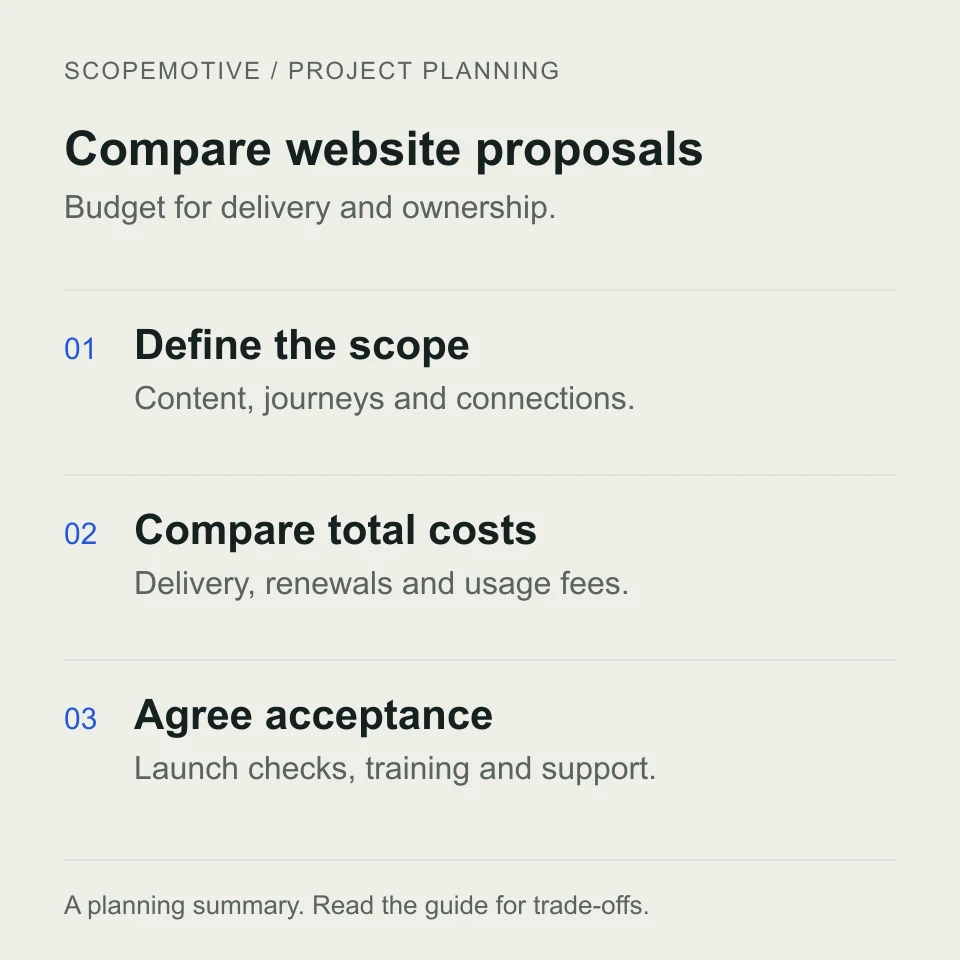
In this guide
A useful website budget starts with what the business needs to deliver. A five-page enquiry website, a personalised-product store and an ERP-connected catalogue have different work behind them, even if their homepages look equally polished. Compare proposals against the same requirements before comparing the totals.
This guide explains how we would scope that comparison. It does not publish a ScopeMotive rate card or claim a market-average price. Your proposal should state the actual fee, assumptions, exclusions and recurring charges for your project.
Separate the three parts of your budget
| Budget area | What to include | What to ask |
|---|---|---|
| Initial delivery | Discovery, design, development, content entry, migration, verification and training | Which deliverables are included, and who approves them? |
| Recurring ownership | Domain, hosting or platform, email, extensions, support and backups | Which costs are compulsory, who bills them, and when do they renew? |
| Usage and future changes | Payment processing, usage-based services and later features | What triggers an extra charge, and how are changes agreed? |
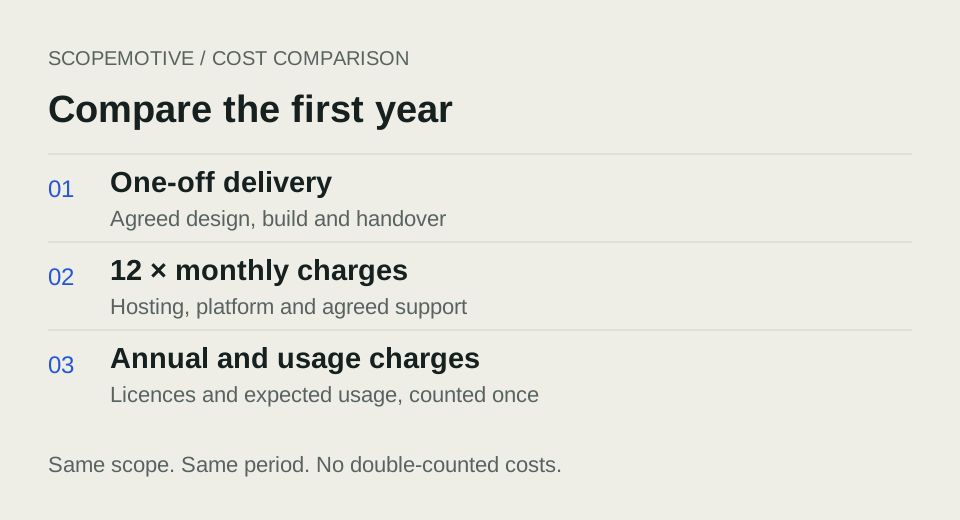
Use one comparison period across proposals. For example, total the initial fee, twelve months of recurring charges and estimated usage for a first-year planning budget. Keep assumptions next to the calculation. Confirm whether each quoted amount includes any applicable tax; do not assume two suppliers present costs on the same basis.
Work through an illustrative first-year comparison
These invented figures demonstrate the calculation; they are not ScopeMotive quotes or typical UK prices. Assume both suppliers deliver the same agreed scope, with equivalent hosting and support. Exclude tax and transaction charges from both columns for this example and compare those separately.
| Cost item | Proposal A | Proposal B |
|---|---|---|
| One-off delivery | £2,400 | £3,000 |
| Monthly ownership charges | £100 × 12 = £1,200 | £40 × 12 = £480 |
| First-year planned total | £3,600 | £3,480 |
The lower initial fee produces the higher first-year total in this example. That alone does not establish which proposal is better: support coverage, ownership, service limits and the actual deliverables must also match. Add any annual licences once, and avoid counting hosting again if the monthly package already includes it.
Explain the work behind the page count
Page count alone hides important differences. A reusable product template may serve hundreds of products, but importing inconsistent specifications, rewriting descriptions or setting up unusual product options still takes work.
The biggest questions to resolve are:
- Content: Who writes, photographs, edits, enters and approves the content?
- Buying journey: Is the action an enquiry, quotation request or completed order?
- Product rules: Do sizes, materials, customer files or personalisation change the workflow?
- Connections: Which systems exchange data, in which direction, and who handles failures?
- Migration: Which URLs, records, images and customer accounts need moving?
- Handover: Who operates the site, and what training, access and support do they receive?
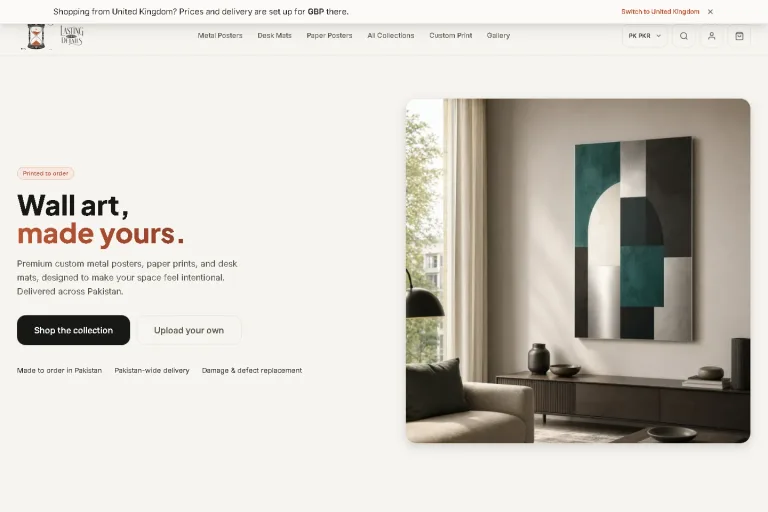
In Lasting Details, material and size choices sit alongside artwork upload and preview. That scope is different from publishing a simple product catalogue. MJ Trader instead uses a multi-item quotation journey. These are examples of delivered functionality, not evidence of a particular price or revenue outcome.
Give suppliers the same comparison brief
Copy this worksheet into your enquiry and ask each supplier to mark every row as included, excluded or requiring clarification.
| Requirement | Your answer | Supplier response |
|---|---|---|
| Main customer action | Describe one successful enquiry or order | |
| Pages and templates | List unique layouts and approximate content volume | |
| Content responsibility | Identify what is ready and what needs producing | |
| Integrations | Name the systems and required data exchange | |
| Existing website | Include the URL and what must be retained | |
| Acceptance checks | List the journeys that must work before launch | |
| Ownership and support | Identify who needs access, training and maintenance |
For an online store, add the three representative orders from our e-commerce briefing guide. For a supplier business, first decide between a catalogue and online checkout.
Compare proposals against a complete journey
Ask how the supplier will demonstrate that the work is ready. A contact form needs more than a confirmation message: the enquiry must reach the agreed destination and give the team enough information to respond. A store needs representative order checks, including the relevant payment and delivery arrangements.
A proposal should also explain revision rounds, dependencies, payment milestones and how extra work is approved. Clarify the difference between correcting an agreed feature and requesting a new one. Record who owns accounts, source code, licensed assets and exports, and what happens at the end of support.
Decide what belongs in the first release
If the budget is limited, prioritise one complete customer journey. An enquiry website can launch with clear service pages, genuine project evidence and a dependable contact route. A store can start with a manageable catalogue and tested fulfilment rules. An ERP should begin with a defined operational workflow.
Reducing scope works best when deferred features are written down and the first release remains useful on its own. Avoid deferring notification delivery, essential accessibility work or the checks needed to operate the agreed journey.
Questions to settle before accepting a quote
Is a fixed price or an hourly arrangement better?
A fixed price needs clear deliverables, assumptions and a change process. An hourly arrangement needs an agreed rate, reporting, spending limits and approval points. Choose the arrangement that makes responsibilities and uncertainty manageable; either can become difficult when the scope is unclear.
Should maintenance be included?
Specify the work rather than relying on the word maintenance. Hosting, updates, backups, restore assistance, fault resolution and content changes may be separate services. Ask what is covered, what response is promised and what is charged additionally.
Can I reduce the fee by supplying content?
Ready, approved copy and images can reduce the work a supplier must perform. Confirm the format, quantity and deadline, and whether editing and entry are still included. Unfinished content can delay design approval and launch.
Prepare for a useful estimate
Send your current URL, sample content or catalogue, required connections and timing constraints. Explain what success means for the business and which tasks your own team can take on. Use anonymised examples rather than private customer records for the initial discussion.
Discuss your website scope or explore website design and e-commerce development. If you are replacing a live site, use our redesign checklist before agreeing the migration scope.