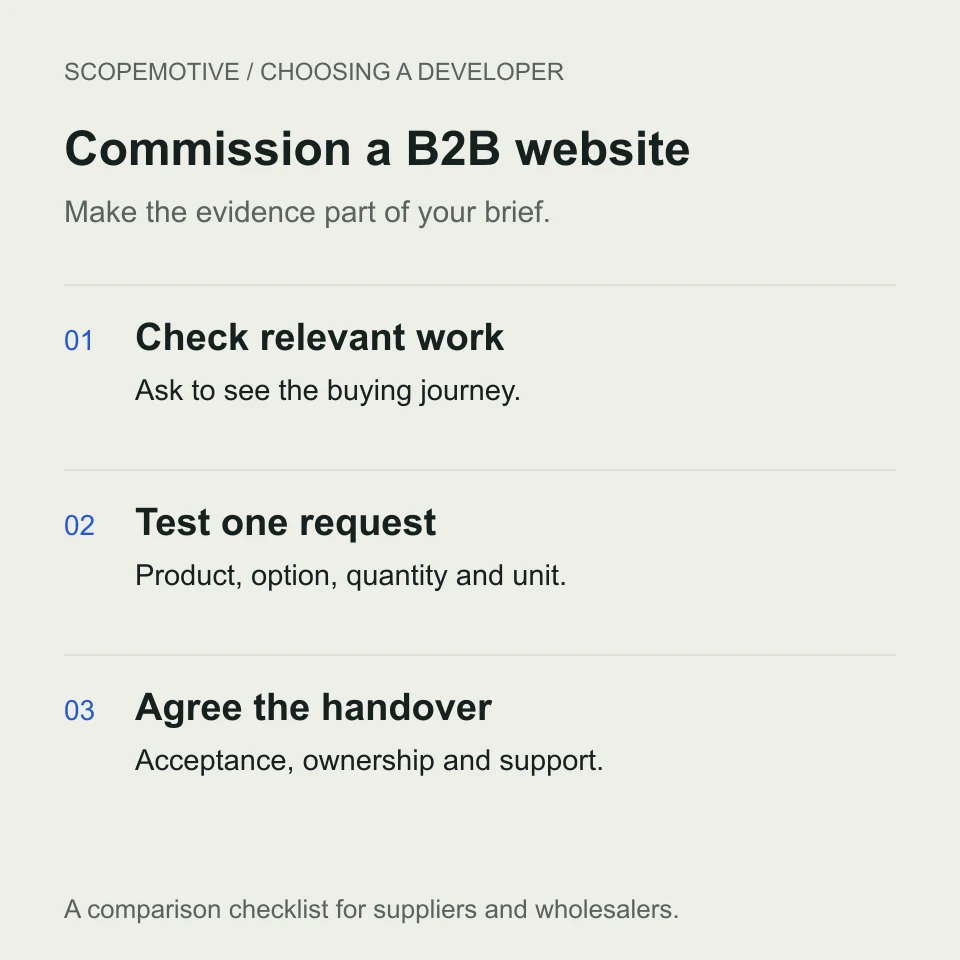
In this guide
To choose a B2B website developer for a wholesale or supplier business, ask each candidate to walk through a real purchasing request. Start with how the buyer finds a product, then follow the quantities, specifications and contact details through to the person preparing the quotation.
That exercise gives you evidence to compare alongside the portfolio and fee. A website for a distributor may need public product information, trade account pricing, a quotation list or a connection to internal stock records. Each requirement changes the work you are commissioning.
This guide explains what to ask, what a useful demonstration looks like and what to put in the agreement.

Define the kind of B2B website you need
“B2B website design” covers several different projects. A manufacturer may need technical product pages and specification enquiries. A wholesaler may need customers to assemble a list of items for quotation. A distributor with agreed customer prices may need a trade ordering portal.
Write one sentence describing your first release. For example, “Buyers can find hardware products, select quantities and send one request for our sales team to review.”
Use our catalogue and checkout comparison if you are still deciding how buyers should proceed. Then ask candidates which parts of that journey they have delivered and which would need discovery.
Ask for a relevant project walkthrough
Choose a project with similar buying requirements and ask the developer to explain their role. Useful questions include who supplied the product data, what the developer implemented and how the business maintains it.
In ScopeMotive’s MJ Trader project, buyers can browse a hardware catalogue, select product quantities and submit a quotation request. Staff have an administration area for catalogue content and incoming requests. That gives a supplier a concrete workflow to discuss when considering a similar build.
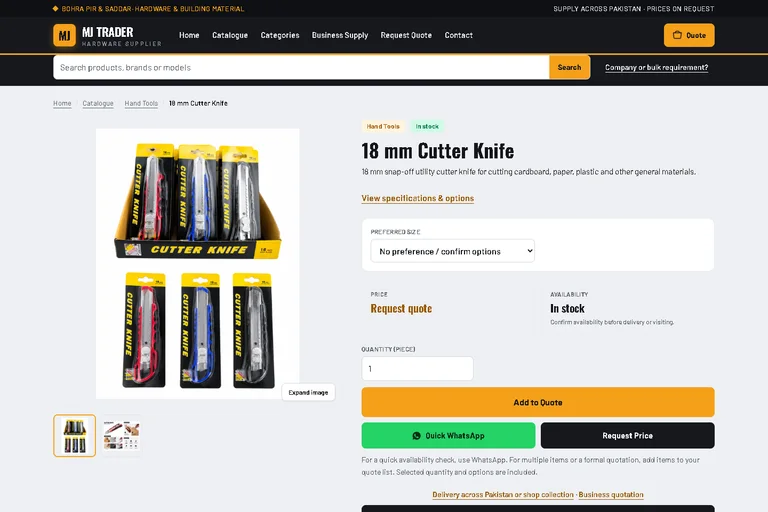
A brochure website can demonstrate design and content work. For a quotation project, also ask to see the request journey. If an administration area contains private records, a demonstration using sample data or a documented walkthrough can show the behaviour.
Ask the candidate to identify delivered functionality and price any proposed additions explicitly, including customer pricing, credit accounts and ERP integration.
Give every developer the same sample request
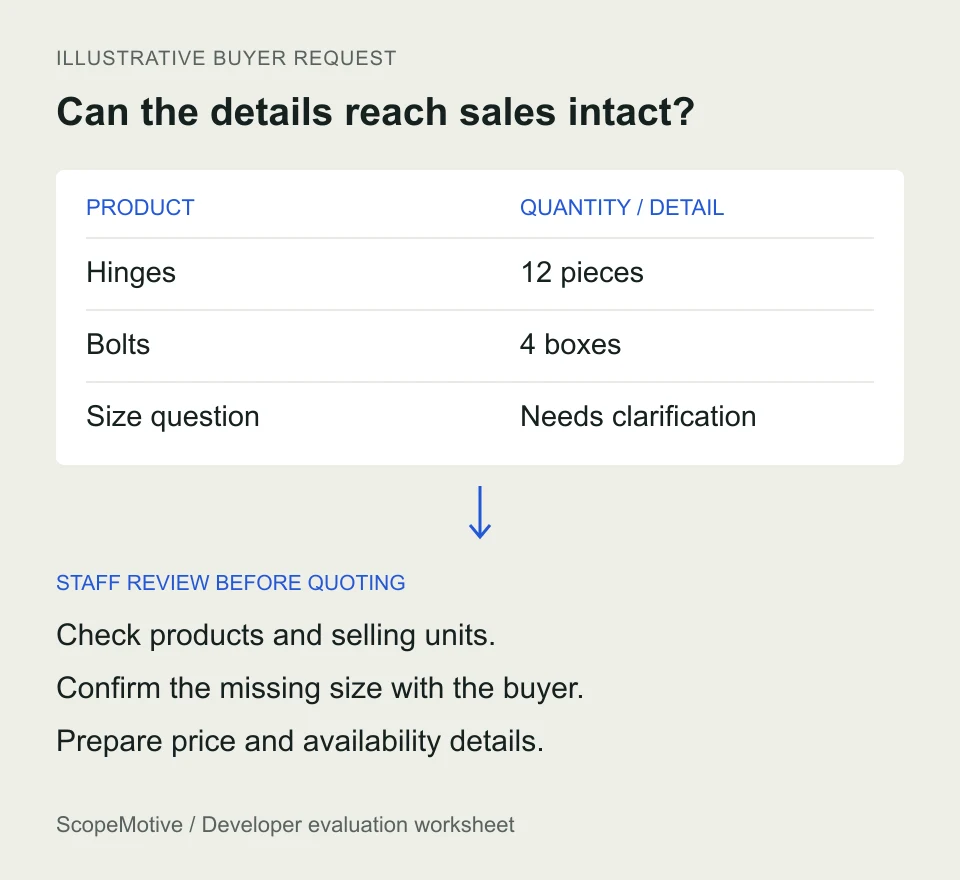
Prepare a small example before requesting proposals. An illustrative hardware enquiry could contain 12 hinges sold individually, four boxes of bolts and one product whose size needs clarification.
Ask each developer how the buyer would enter those requirements and how staff would receive them.
| Check | Evidence to request |
|---|---|
| Product identity | A product reference and selected option remain attached to each request line. |
| Quantity and unit | Buyers can distinguish pieces, boxes and other selling units. |
| Review | Buyers can inspect and correct the list before sending it. |
| Delivery | The responsible team receives the agreed details and can find the saved request where included. |
| Failure | A failed submission gives the buyer a usable next step. |
| Follow-up | Staff know who owns the request and how to record clarification. |
Agree which fields are required and explain unfamiliar inputs beside the relevant control. W3C’s form guidance recommends instructions covering required inputs, formats and other information people need to complete a form. W3C form instructions
Compare platform choices against your requirements
Ask the developer to explain why the proposed platform fits the catalogue, staff workflow and maintenance arrangements.
An existing ecommerce platform with an extension may cover a straightforward quotation journey. WooCommerce documents a Request a Quote extension that lets customers add products to a quote basket and request an estimate. This establishes an available implementation route. You still need to verify the chosen extension against your requirements and ongoing costs. WooCommerce extension documentation
Custom development may be worth considering when the required workflow, permissions or connections need behaviour that the available tools cannot support suitably. Ask the candidate to demonstrate the difficult part before you commit to a larger build.
Compare recurring licences, who maintains the software, how updates are tested and what happens if a dependency changes. Include those responsibilities in the proposal.
Make product data and integrations explicit
A catalogue project needs agreement about who supplies names, references, specifications, photographs, categories and selling units. Ask how inconsistent supplier spreadsheets will be handled and who approves the imported result.
For each integration, identify the system that owns the record. If the website displays stock, decide how current it must be and what buyers see when the connection fails. If enquiries feed into an ERP, agree whether the first release creates a request, a quotation or another record.
Ask for a written boundary around each connection. “ERP integration” needs a list of records, directions of transfer, update triggers and failure handling before it becomes a priceable deliverable.
Our ERP development service explains the discovery inputs for the internal workflow. A catalogue and its business system can be scoped together when the project requires that connection.
Compare the complete delivery scope
Give shortlisted candidates the same brief and ask them to mark the work included in their fee. Check discovery, design, content entry, imports, development, testing, training and support.
Ask how later changes are priced and how assumptions affect the estimate. A product count helps size the import, but variations, data cleanup and search rules can create work beyond that count.
A developer can give an early budget indication using written assumptions, then refine it once these details are agreed. Use our website quote comparison guide to compare initial delivery and recurring costs over the same period.
For a replacement site, include the current URLs, downloads and redirects. Google recommends mapping existing addresses to their new destinations and monitoring the move. Ask who prepares that mapping and who tests it. Google’s site migration guidance
Use a comparison worksheet
Copy these questions into the brief you send to each shortlisted developer. Record the answer and any excluded work beside the quoted fee.
| Proposal question | What to record |
|---|---|
| What will you demonstrate? | A relevant project, the candidate’s role and the workflow you can inspect. |
| Who prepares catalogue data? | Import format, cleanup responsibility and who approves the result. |
| How will requests reach sales? | Included notifications, saved records, failure handling and staff ownership. |
| What does each connection do? | Named records, transfer direction and the behaviour when an update fails. |
| What will we pay over the first year? | Delivery, licences, hosting, support and assumptions about usage. |
| How will we accept and maintain it? | Written pass conditions, account access, training and support terms. |
Should you hire a freelancer or an agency?
Ask who will do the work and who is available when the project needs support. With an independent developer, clarify their availability, specialist dependencies and cover arrangements. With an agency, identify the delivery team, your day-to-day contact and who approves changes.
Compare relevant evidence, capacity and contractual responsibilities against your project. If several teams need to launch connected systems together, ask how that coordination will be managed.
Agree acceptance and handover before signing
Write the checks you will use to accept the website. Include a mobile buyer journey, a request with several items, a correction to a quantity and a failed submission.
Name the staff member who approves the catalogue and the person who verifies enquiry receipt. Confirm access to the domain, hosting, source code or platform account, analytics and any paid extensions. Record the licence and ownership terms in the agreement.
For handover, ask a member of your team to update a product using the instructions provided. Agree backup and recovery responsibilities, support arrangements and the process for requesting changes.
These checks turn phrases such as “easy to manage” into tasks that both sides can assess.
Prepare your first conversation with a developer
Bring a sample catalogue, two or three typical buyer requests, the current website address and a list of systems involved. Explain who maintains products and what the sales team needs before quoting.
ScopeMotive builds catalogue and quotation websites for suppliers and wholesalers. You work directly with founder Hussain Khuzema through scoping, development and handover.
Explore our B2B catalogue development service to see the approach and project evidence, or send your supplier website requirements.